INTRODUCTION
Haitian art has never been so diverse and we’d do well to believe it doesn’t intend on reaching a breaking point in the realization of its possibilities. The closure of the only art museum and the confinement of galleries to the single neighborhood of Pétion-Ville since the January 12, 2010 earthquake might suggest a sort of stagnation in artistic practice. And yet, everything moves. Despite a lack of guidance and the challenging state of the art market, artists continue their work. Artistic output aspires to be both engaged and inventive. Among the most inventive artistic work is that of Rénold Laurent. As a visual artist, poet, and novelist, his art is part of an ongoing search. From the outset, he always refused ease, spontaneity, or improvisation.
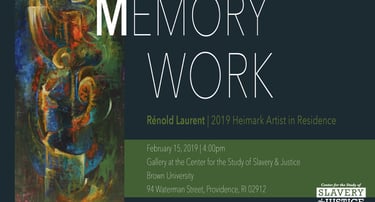
Rénold’s artistic journey has been both rigorous and rapid. He has constructed his art with soberness and discipline. Can one speak of phases in Laurent’s art practice? Refusing any idea of art that emerges from spontaneity, he’s inclined towards an aesthetic achieved through gradualness. His introduction to art historian Michel Philippe Lerebours was decisive to this approach. It was at this point he realized that art can only be a methodic construction. Thus, he began taking up the great masters of Western art in order to perfect his technique. In this sense, he was above all influenced by Manet. However after some time, figurative could no longer provide the necessary momentum for his creative vision. From 2005–2007, he exhausts himself working in and through Kandinsky’s interpretation of abstract lyricism. And from this process his style surges forth. Clouds of color emerge from the canvas, expressing the extreme fragility of human things. While not wanting to represent reality, his work emerges from the human condition of tragedy. His artwork is constructed like a fog of colors, and in a slow movement, forms appear and timidly fade to make room for others. One cannot forget abstractions the color of re where the canvas becomes a eld invaded by streams of lava exploding in sparks.
ARTISTIC THEMES
Rénold Laurent’s artistic journey inspires a lot of interest and many questions. The thematic diversity of his artwork seems to make him an inclassable artist, sometimes misunderstood. He isn’t attached to any particular gallery, but that isn’t as much of a disadvantage in Haiti as it’s typical even for the most well-known artists. What’s surprising is that he’s never been exhibited by a gallery in Haiti, despite recognition by the biggest art institutions, namely the Musée d’Art Haïtien and Centre d’Art. In effect, if Laurent’s work disturbs, it’s because of both its variety and resistance. If his work addresses traditional terms of Haitian modernism, like market scenes or popular expressions of Haitian culture such as “Rara” or “Trese Riban,” or even abstraction (which seems to be his true path) it has also distanced itself from this modernity; for this reason art critic Webert Lahens has situated Laurent’s artwork in the history of artistic postmodernism in Haiti. Through his abstraction, Laurent makes a new proposition. His work is an act of resistance. Looking at the artists of his generation, one could say Laurent assumes the figure of a UFO. He completely refuses the forms and colors his contemporaries adore. One could say that he is from another time, “le tien”; but while relying on a time that has already existed, he surpasses it. Thus the question, what is Rénold Laurent’s place in contemporary Haitian art? And can his artistic journey help us to answer it?
Despite his technical evolution and his preference for abstraction due to hours spent drawing and reproducing the French impressionists of the 19th century, he remains attached to the initial themes of his training. Raised in a family of painters, from childhood Laurent took up the stylized forms that his father and brothers were drawing and painting: scenes of everyday life where people are most often placed in rustic landscapes and space is reduced to a bare minimum. But encountering Lerebours at the end of the 1990s marked an occasion that would change his conception of art and give his artistic practice its true momentum. This meeting was a confirmation of his artistic vocation. It’s at this time he began to study. Lerebours’ library offered him everything, from philosophical aesthetics and the aesthetic vision of Etienne Souriau and his followers, to the major currents in global and Haitian art history. He devoured novels and poetry, and thus, began writing. He published several collections of poetry with Choucoune Edition whose owner is none other than Christophe Charles, one of the most famous poets in contemporary Haitian literature.
With a preference for the impressionists, and more specifically, portraiture and still-life, he worked on his drawing skills by copying the masters, theoretically and practically exploring major artistic movements. For a while, he looked for a means of expression through realistic forms. Towards the end of the 1990s and the beginning of the 2000s, going against the trends popular among artists of his generation, he chose abstraction. He refuses to paint in search of direct representation, whether it be realistic or figurative. Hereafter, it’s more a question of meaning than saying. He offers us a more interior kind of painting, one that speaks to the soul, where forms seem to peer into our deepest emotions, and give the strange sensation that the world is a great blue background on which lines and colors play. In certain pieces, the colors seem to spring from nowhere; the shapes appear tormented by some sort of tragedy. The struggle of colors—peaceful here, violent there—gives rhythm, directing the gaze while interrogating what it means to see. But how many times have we not witnessed this majestic layout, which explodes the usual circle, where forms are taken up in a network that propels them towards a new reality, however elusive it may be, mistaken as easy or low-brow? The movements are slow and orderly, testimonies not to a found serenity or satis ed soul, but rather a disciplined spirit dreaming of order.
COLORS AND TECHNIQUE
At other times, Rénold more aggressively expresses his concerns, transforming them into a kind of revolt. In these cases, despite the presence of vertical lines that provide a degree of measure to the movements, shapes utter and colors ow, streaming into one another. Everything degenerates. Total agitation prevails. The rhythm strikes like emotions tearing themselves apart. By 2006–2007, Laurent began experimenting with new materials, such as coffee or the integration of found objects into his pieces. In 2008, he presented the works that emerged from this experience to the public at his first major exhibition and the last major exhibition curated by the Centre d’Art before its destruction in the earthquake of January 12, 2010.
The public discovers his audacious dichromatic technique. If black and white pervade his paintings, he uses them as an opportunity to execute a total art. This total art is made through collage and recuperated materials, always worked with a certain neatness. Thanks to marouflage, and to a collage technique that gives depth to his pieces, the canvas becomes painting and sculpture simultaneously, placing it at the cutting edge of visual expression.
This effort to create a total art makes him an artist of synthesis and a great illustrator and fashion design teacher. His skill for abstract painting would be the envy of even the genre masters, however figurative remains a cheval de bataille of the highest importance. We can then say that the figurative remains an anchoring point in his work, a source of inspiration even if, at the end, his major pieces are non- figurative.
Rénold Laurent is undoubtedly a treasure in contemporary Haitian art. Tireless in his pursuit, each piece is a step toward the unknown, towards the search for a world where exploration remains endless. His work is part of an approach that interrogates artistic practice in its entirety. He brings into question the relationship between painting and other art forms, whether he practices them or not. For him, art is the only means of understanding the things that happen and the things that remain. His practice is an effort in constant renewal, one that outright refuses ease or compromise.
Dichromatic experimentation permitted Laurent to invent a style less evocative in regards to color, but one that offers us works of astonishing brilliance in the imaginative and suggestive force they elicit. If the variation in color and the play of gradation are diminished, we dare to argue that we are in the presence of another conception of the artist and his art entirely. He has completely unleashed his own audacity. If art still must devote itself to harmony, it isn’t in the homogeneity of the materials and even less so in the grandeur of the substances themselves. Now, he doesn’t hesitate to integrate objects into his paintings—or better yet his tableaux. When painting is incorporated, it’s only in order to accentuate certain features: a bra, a piece of tissue or jean, wood etc. Through the breath of his imagination, recuperated objects, trash that had already reached its final destination in landfills, acquire a new life. These works of assemblage for some, collage for others, mix artistic mediums. If, in his aesthetic quest, Laurent returns to collage or to assemblage, it’s by no means a playful do-it-yourself project nor a means of simply jarring the gaze. To the contrary, the elaboration of his form is harmonic and always brings the gaze towards a center. Situating himself in the wake of those who wanted to break the boundaries between art forms, or better yet, the artistic and the non-artistic, Laurent shows the richness in the encounter between diverse elements. Perhaps this is why he stripped his landscapes: in order to make room for the bare necessities. Once integrated into the landscape, once the objects become forms, they seem as though they no longer want to announce themselves as individual entities. They adapt to the point where they forget themselves. We interpret this integration not as a loss of individuality, but rather as an encounter of several individualities in the midst of shedding their differences—a utopian interpretation perhaps! Moreover, it’s clear in Laurent’s work that he doesn’t attempt to hide the nature of the objects. The initial form releases itself entirely, taking its place in the whole.
QUEST AND TRANSFORMATION
In essence, the aesthetic force of Laurent’s artwork, without wanting to reduce it, can be approached from three angles: the quest to transform materials, the synthesis of various artistic currents, and technical innovation. Laurent pursues a form of mixture where the artistic and the non-artistic rub shoulders. The impact of this mixture on our prevailing artistic sensibilities is often unsettling, but it permits the total integration of environment into art. Whether we like it or not, art is a medium for understanding nature; it always interrogates our existence. And we often feel overwhelmed by the weight of our questions. Nature seems too big; in order for us to explain it, we try to fragment it. Laurent studied the artistic movements that wanted to fragment nature in order to understand it, but he did not follow them. His vision, in my opinion, yearns to be total. This is probably what he intends to wrest from the heterogeneity of his materials. Laurent rarely gives a title to his pieces—and this isn’t a passing fad either. For him, art is just as much a manner of living as it is a way of doing. And life is mysterious; an ethereal thing that I cannot picture for myself without the sadness of lying to myself. Yet, Laurent never blames life. To the contrary, he represents it with grandeur of the work itself. One of the rare pieces he has titled is called “Waves.” We’re here caught up in our circumstances and it’s in confronting them that we get, if not the opportunity to know ourselves than at least the chance to evaluate our possibilities. Herein lies the greatness of life—it always enables this possibility for reaction.
In reality, Laurent never abandoned color. Three foundational events of his artistic career allowed him to return to the public with artwork rich in color and confirmed his place in the Haitian art world. First, he was chosen by the directors of the l’Institut d’Etudes et de Recherches Africaines d’Haïti de l’Université d’Etat d’Haïti to produce a wall fresco in 2013.
It was created in collaboration with Philippe Antoine, art professor at the l’Ecole Nationale des Arts à Port-au-Prince. The fresco is four by two meters, revealing the true scope of his talent as an artist. If he had already familiarized the public in Jacmel with his large scale works, it was the first time that the people of Port-au-Prince had the opportunity to react on a piece of this scale. This project had such a positive impact on the university community that the directors of the institute organized a large exhibit for Laurent entitled Expression and Abstraction in 2015 where he was connected with a sculptor from Rivière Froide named Karim Bleus. This exhibit received extraordinary media coverage. On this occasion, Laurent had the opportunity to meet Simil, a treasured giant of artistic modernism in Haiti, who praised Laurent’s discipline and extensive knowledge of colors. The next year, in June 2014, he was invited to participate in the 34th edition of the “Fiesta del Fuego” at the Casa del Caribe de Santiago de Cuba. One of Laurent’s pieces was depicted on the cover of the catalogue, “Caminos Poeticos” which brought together the work of Cuban and Haitian poets. Once again, the experience in Cuba allowed him to question his work and his conception of art. He returned from this trip with works dominated by a very yellow color. This was the first time in Laurent’s work that a real presence of the color yellow emerged. At the level of form, he became more sensitive to symbols. From there, he mixed his lyricism with geometric symbols.
His last major exhibition in Haiti took place at the Cultural Center of Brazil. More than thirty works were exhibited. The exhibit bene ted from several newspaper articles. Two notable conferences have been convened by two art historians, Jean Herald Legagneur and Sterlin Ulysse. These conferences have sparked a lot of debate on the question of abstract art in the history of Haitian art, and created a real dialogue between artists, theorists, and the public.
Today, Laurent moves towards a much more hectic, more disturbing form of abstraction. The entirety of his work tries to organize itself around a force of constant movement, whether it be a circle, or a sphere, or a spiral. When the forms are not captured by waves, they are caught by spirals that deform them. The agitated atmosphere of Laurent’s most recent works plunges us into the chaos of a beginning or of an end. One the living man, the unknown, the lost one, the adventurer who leaves his head full of illusions and heads towards the dark horizon.
The artistic journey of Rénold Laurent is not only an aesthetic search: it’s also a quest for the self. If his visual work is a constant evolution, in order to break boundaries, he had to do it in his own life by pursuing several forms of artistic ex- pression. And if he was born in a family of painters, he is the rest and the only to overcome technical and social obstacles in order to evolve his art. His birthplace, in the south east of Haiti near Jacmel, has given Haitian art several of its most cherished artists, including the Domond and Celestin Faustin. If the area still possesses artists and artisans who combine gardening or other concerns with the practice of art, there’s no one highlighting this generational interest in artistic creation. There’s a reason Laurent founded the Centre Culture Soley Leve. He always wanted to help people, and more specially children, to realize the importance of the relationship between art and life. He has put his popularity as an artist in the service of his community. It’s this sense of commitment that attracted the team of “France O,” a French television program, when they decided to report on this center. The artistic journey of Rénold Laurent is above all else an effort to open, to encounter the other. This is perhaps the best explanation of his evolution to an abstraction methodically researched. Thus, his return to the figurative from time to time should not be understood as a need for inspiration as much as a return to origins in order to continually surge forth.
Sterlin Ulysse
Dr. Sterlin Ulysse received his PhD at L’Ecole Normale Supérieure a— Université d’Etat d’Haïti, Port-au-Prince and the University of Toulouse-Jean Jaurès, France, in Ibero-American studies with a concentration in art and literature. Currently, he is Vice-Dean of research at Institute of African Studies and Research in the Higher Institute of Studies and Research in Social Science at the State University of Haiti. He also works with the FRAMESPA (France, Americas, Spain—Societies, Powers, Actors) laboratory.
THE ARTISTIC JOURNEY OF RÉNOLD LAURENT